
A Pro's Guide to Nitrous Oxide Tanks for Canary Islands Venues
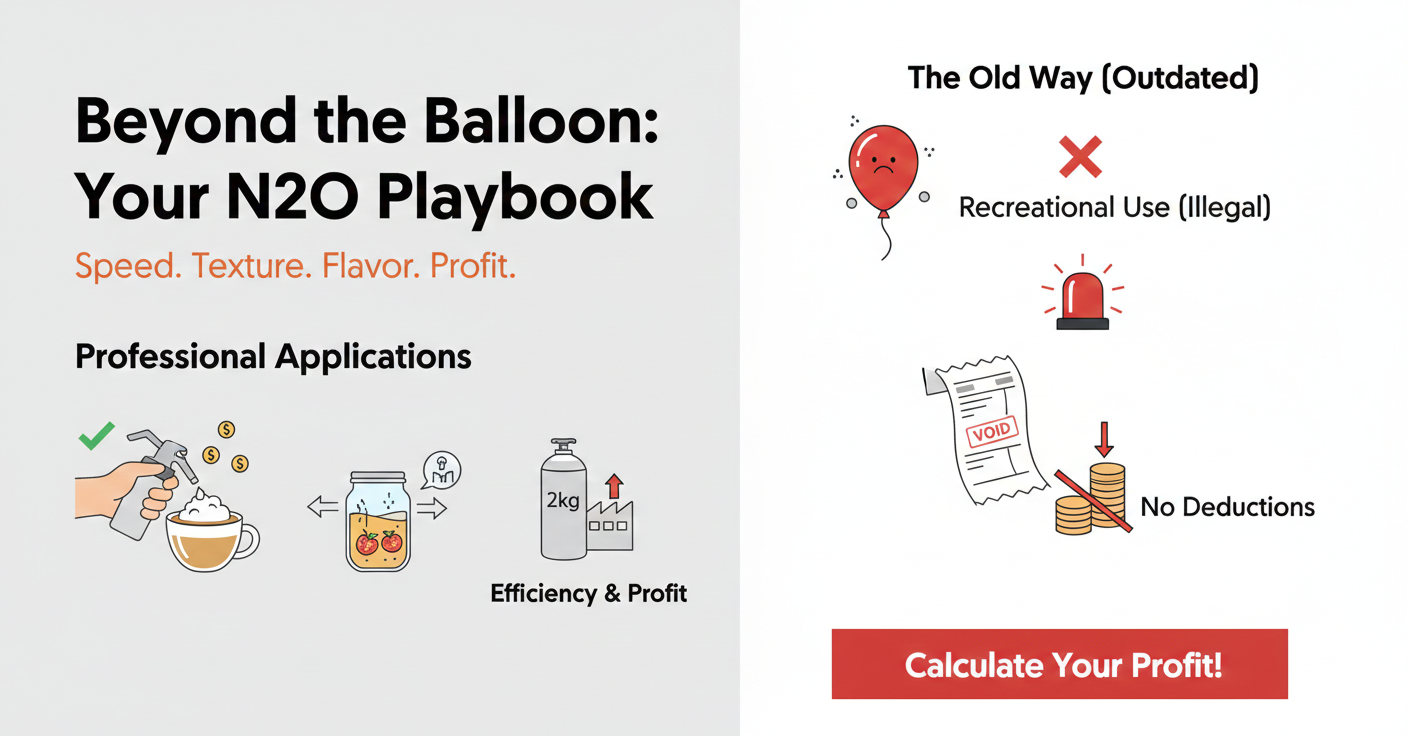
When most people hear nitrous oxide tanks they think of balloons. But for those of us in the trade, that’s just scratching the surface. In today's hospitality scene, these canisters are a critical tool for speed, texture, and flavour—a secret weapon for standing out. It’s how you get an edge, whether you're behind the bar or in the kitchen we know that it's already in peoples favourite foods & drinks.
Summary: This guide provides hospitality professionals in the Canary Islands with practical, actionable information on using bombonas óxido nitroso (food-grade E942). It covers the creative culinary applications beyond whipped cream, offers a data-driven approach to choosing the right canister size (from 666g to 2kg), and details the critical importance of safety certifications (ISO, CE) and 99.9% purity. Furthermore, it outlines essential protocols for safe handling, storage, and local compliance with IGIC invoicing, emphasizing the strategic advantage of partnering with a local B2B supplier for reliable, same-day delivery.
Key Takeaways
- Creative Advantage: Use E942 for rapid infusions, velvety espumas, and texturally unique cocktails to elevate your menu and operational efficiency.
- Smart Sourcing: Choose canister sizes based on daily output and cost-per-charge data to optimize inventory and reduce waste.
- Safety is Non-Negotiable: Only use certified 99.9% pure E942 nitrous oxide from suppliers who provide ISO and CE documentation.
- Proper Handling is Essential: Store canisters upright in a cool, ventilated area below 50°C and follow strict protocols for attaching regulators.
- Local Compliance is Key: Ensure all purchases are B2B transactions documented with a proper IGIC-compliant invoice to stay audit-proof.
- Local Supplier Advantage: A local partner with same-day delivery options provides logistical stability, better cash flow, and prevents costly stockouts.
Unlocking Culinary Creativity with Nitrous Oxide
In the fiercely competitive hospitality world of the Canary Islands, you’re always looking for that one thing that sets you apart. Food-grade nitrous oxide (known in the industry as E942) has quietly become that differentiator for top chefs and mixologists. It’s the key to moving beyond the basics and turning standard ingredients into something truly memorable, with a speed and consistency that’s impossible to achieve by hand.
I like to use an analogy: using industrial gas instead of culinary-grade N2O is like making a high-end coffee with unfiltered tap water. Sure, it’s still coffee, but you’ve just ruined the delicate notes of the bean with impurities. Only certified E942 nitrous oxide guarantees a clean result, free of the industrial oils or metallic aftertaste that can instantly tank a customer's experience.
More Than Just Whipped Cream
The real magic of professional bombonas óxido nitroso is just how versatile they are. For a cocktail bar in Playa de las Américas or a fine-dining spot in Las Palmas, this isn't just about novelty; it’s about real, tangible benefits that boost both quality and efficiency.
Here’s how the best venues are putting it to work:
- Rapid Infusions: A process that used to take weeks—like steeping vodka with fresh herbs or citrus peels—can now be done in minutes. The intense pressure inside the dispenser forces the liquid into the solids, extracting deep flavour and aroma almost instantly.
- Velvety Foams and Espumas: N2O is brilliant at creating light, incredibly stable foams from almost anything, not just cream. Think savoury vegetable espumas or delicate fruit foams that add a professional touch and texture to a dish without making it heavy.
- Elevated Cocktails: Mixologists are using it to create signature drinks with unique textures. Imagine an airy, citrus foam on a margarita or a perfectly smooth, nitrogenated cold brew for an espresso martini that blows the standard version away.
Any professional chef or bar manager will tell you that consistency is everything. Culinary nitrous oxide gives you a reliable way to aerate, infuse, or foam ingredients perfectly every single time. It takes the guesswork out of the equation, ensuring every guest gets the exact same high-quality experience.
Ultimately, getting comfortable with E942 is about more than just learning a new technique. It's about unlocking a new level of creativity and making your prep workflow much, much smarter. For hospitality operators here in the Canary Islands, it's a straightforward way to streamline processes, add exciting new items to the menu, and deliver the kind of five-star quality that keeps people coming back.
Choosing The Right N2O Canister For Your Business
When it comes to nitrous oxide canisters, one size definitely does not fit all. The right choice boils down to a constant tug-of-war between cost, yield, and the sheer speed of your service. For managers in bustling hubs like Tenerife, Gran Canaria, and Lanzarote, picking the optimal canister format is a decision that directly impacts your bottom line.
This guide will walk you through the options, from compact 666g cylinders perfect for smaller setups to hefty 2kg tanks built for high-volume resorts. We’ll look at the real cost per use, smart storage tactics, and how the right canister can even unlock new creative infusions to keep your menu ahead of the curve.
Think about your daily output:
- A compact 666g cylinder can deliver up to 120 servings from a single canister.
- The standard 1kg canister is a workhorse, balancing portability with around 180 topping yields.
- For the busiest bars, a large 2kg tank is the way to go, giving you over 360 charges before you need a refill.
Analysing Key Canister Factors
The size of the canister you choose has a direct ripple effect on everything from your cost per serving to how often your team has to stop mid-service for a swap.
Smaller cylinders are fantastic for saving space, but they’ll need turning over much faster in a busy cocktail bar. On the other hand, larger tanks are brilliant for reducing that refill downtime, but they demand secure storage and proper handling protocols. It's a classic trade-off between convenience and capacity.
Comparing Nitrous Oxide Canister Options
To make things a bit clearer, I've put together a quick comparison of some of the most popular options we see across the islands. This should help you match the right bombonas óxido nitroso to what your venue actually needs on a day-to-day basis.
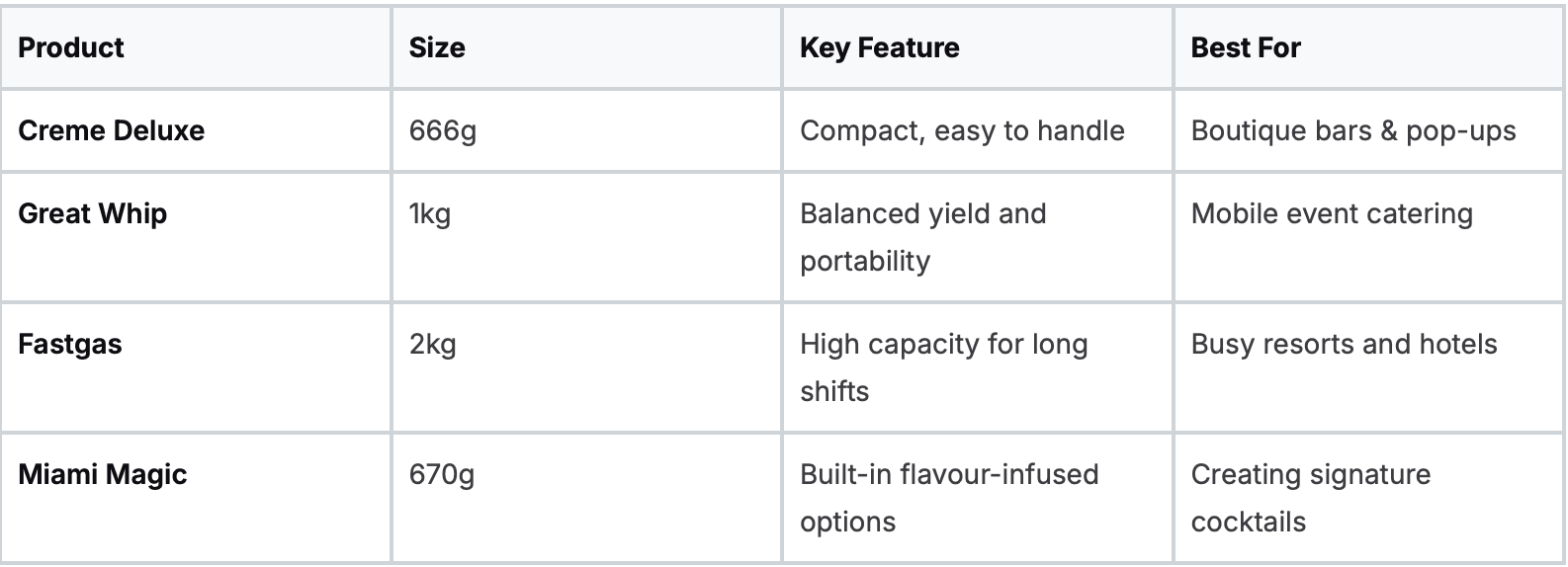
For a high-turnover bar in Playa de las Américas, the ability to do quick swaps might be more valuable than sheer capacity. But for a resort kitchen prepping for a buffet, the larger tank is a no-brainer. This table is a starting point—your specific workflow will tell you the rest.
Here's a simple decision tree I share with clients. It helps clarify why sourcing the right type of gas is just as important as the size.
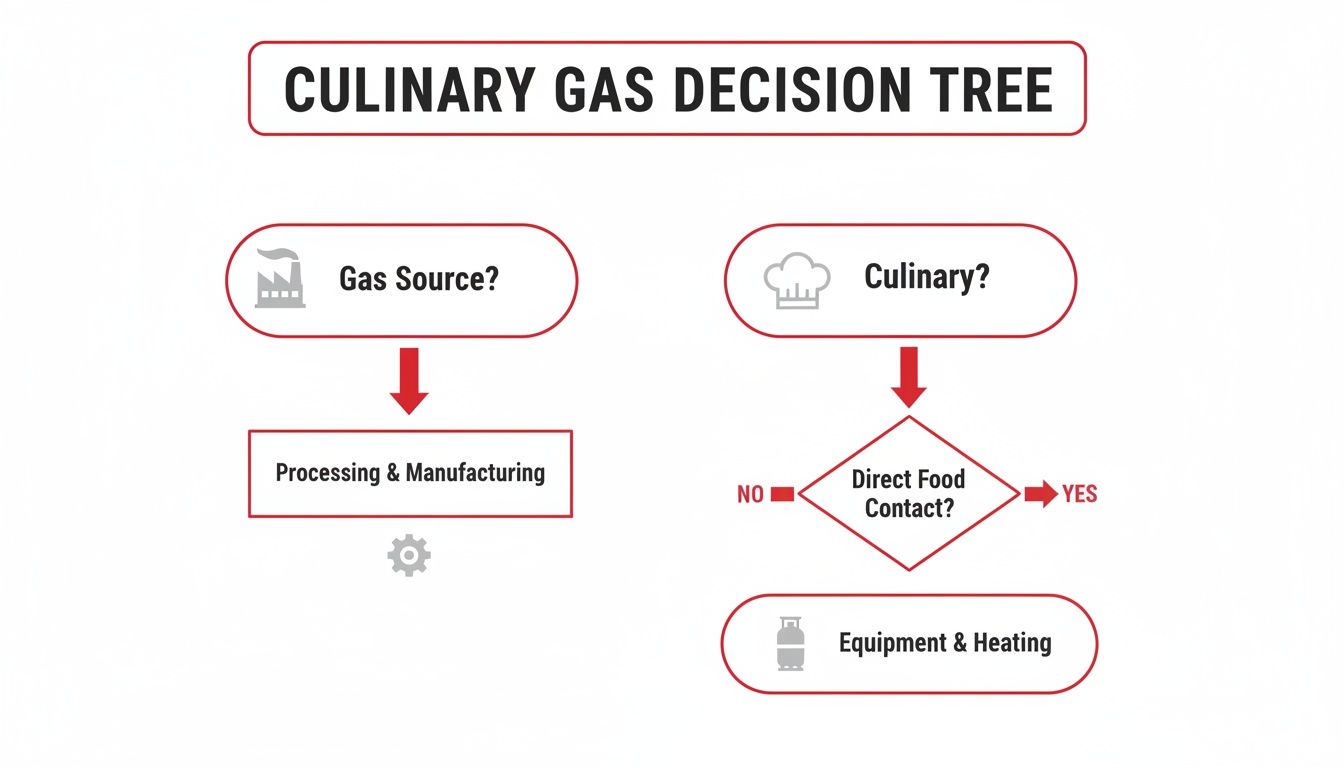
As the flowchart shows, sticking to verified culinary gas sources isn't just about compliance; it's your guarantee of purity and safety for anything that touches a customer's plate or glass.
Balancing Cost And Efficiency
Let's talk numbers. Understanding the price per charge is how you move from guessing your expenses to forecasting them with precision.
A 666g canister might cost you around €6 and give you between 100–120 servings. In contrast, a 2kgtank averages about €18 but delivers over 360 charges, which significantly drives down your cost per use.
- The 666g cylinder works out to about €0.06 per charge, making it a great, low-commitment option for pop-up bars.
- A 1kg canister brings that down to an average of €0.05 per serving in mid-volume settings.
- With a 2kg tank, high-turnover venues can get their cost down to €0.05 or less per use.
By keeping an eye on your weekly usage, you'll know exactly when it’s time to size up before you risk a stockout. Marrying your cost data with your service metrics is how you make truly informed procurement decisions.
"Accurate forecasting cut our gas spend by 15% in six months. It’s that simple." – Beverage Director, Gran Canaria Resort
Exploring Flavour Infused Canisters
Want to speed up your prep without compromising on creativity? Flavour-infused options like Miami Magic are a game-changer, offering profiles like strawberry, watermelon, and various candy notes.
These canisters streamline your workflow by combining the propellant and flavour into a single step. Bartenders I've spoken with report 25% faster service times when using these for signature drinks, as it cuts out an entire stage of the mixing process.
For a deeper dive into how different sizes stack up on yield and cost-effectiveness, have a look at our detailed breakdown.
Check out our guide on 580g vs 2kg N2O cylinders for deeper yield and cost comparisons.
Making Data-Driven Decisions
So, how do you put this all together? Start by assessing your average daily charges and matching that to a canister's lifespan. Then, factor in your available storage space, how often you can get deliveries, and what your service looks like during those peak rushes.
A well-chosen canister doesn't just make service smoother; it actively protects your profit margins by reducing waste and downtime.
- Keep a mixed inventory. Have a couple of different cylinder sizes on hand to adapt between your busiest and slowest days.
- Schedule smart. Time your deliveries to match inventory forecasts so you avoid tying up cash in overstock.
- Train your team. Make sure everyone knows how to perform quick swaps and handle canisters safely to keep service flowing without a hitch.
By selecting the right bombonas óxido nitroso, you're not just buying a consumable; you're investing in a more efficient workflow and the consistent quality your guests expect.
Case Study: A Fuerteventura Resort Switches Up
I recently worked with a flagship resort in Fuerteventura that made the switch from 1kg to 2kg tanks right in the middle of the high season. The impact was immediate.
They managed to reduce their refill interruptions by a massive 60%, which dramatically improved guest satisfaction at their busy pool bar. Better yet, the switch cut their gas spend per charge by 20%, freeing up budget that they immediately reinvested into menu innovation. It’s a perfect example of how a simple logistical change can have a huge operational and financial payoff.
When it comes to sourcing bombonas óxido nitroso, nothing matters more than purity and safety. This isn't just about flavour; it's about your legal liability, your reputation, and the well-being of your customers. Every single canister that comes into your kitchen has to be verified, food-grade E942. That guarantee comes from clear, non-negotiable certifications.
For any of us working in the Canary Islands hospitality scene, these certifications are our shield. They protect us from contamination, inconsistent results, and the kind of health code violations that can shut a place down. I always tell new managers: you wouldn't serve seafood from a dodgy, uncertified supplier, so why on earth would you use a gas that directly infuses into your products without the same level of scrutiny?
Decoding the Marks That Matter
When you see logos like ISO or CE on a product, they aren’t just for decoration. These marks are the end result of rigorous testing, traceability, and a commitment to quality control that protects your business. Understanding what they mean is the first step in responsible sourcing.
- ISO 9001/9002: Think of this as the blueprint for quality. A supplier with ISO certification has proven, documented processes for consistency and safety, from the factory floor to your delivery van. It means they have a robust system in place to prevent errors and ensure every canister meets the same high standard.
- CE Marking: This is a big one. It's the product’s passport for the European Union, indicating it complies with the EU's health, safety, and environmental protection standards. For a pressurised gas cylinder, this is your guarantee that the canister itself is built to be safe and won't fail under normal kitchen pressure.
- AESAN Compliance: The Spanish Agency for Food Safety and Nutrition (Agencia Española de Seguridad Alimentaria y Nutrición) sets the rules for food-grade products here in Spain. A supplier who adheres to AESAN standards is confirming their E942 is handled and distributed in a way that’s completely safe for human consumption.
These three work together to create a chain of trust. ISO ensures the process is sound, CE confirms the hardware is safe, and AESAN compliance validates its suitability for your kitchen.
Why 99.9% Purity is the Only Number That Counts
The standard for food-grade E942 is a purity level of 99.9%. That leftover 0.1% might seem tiny, but in non-certified products, it can hide a nasty cocktail of industrial gunk. I'm talking about machine oils, metallic specks, and moisture—all things that will kill your final product.
Even the smallest trace of these contaminants can introduce foul, oily off-flavours that ruin a delicate foam or a subtle infusion. More importantly, they pose a genuine health risk. A certified product guarantees the nitrous oxide has been properly filtered and purified for one thing and one thing only: culinary use. That means a clean taste and absolute safety.
The moment you compromise on certified purity, you're no longer just making a drink or a dish—you're gambling with your customer's experience and your establishment's good name. Only source sealed, certified bombonas óxido nitroso. Every single time.
A Practical Checklist for Vetting Your Supplier
Protecting your business starts with asking the right questions and knowing what to look for. Use this simple checklist to vet any potential nitrous oxide supplier in the Canary Islands.
- Demand the Paperwork: Ask for copies of their ISO and CE certifications. Any distributor worth their salt will have these on hand and be completely transparent about their supply chain. If they hesitate, walk away.
- Inspect the Labels: Every canister should be clearly marked with its E942 food-grade designation, the 99.9% purity level, and the manufacturer's details. Vague or missing labels are a massive red flag.
- Confirm Traceability: Can the supplier trace a canister’s batch number back to its source? This is a core part of food safety and a non-negotiable requirement of ISO 9001.
- Check for Professional Invoicing: Make sure they provide a proper, IGIC-compliant invoice with a valid CIF/NIF. This isn’t just for your accountant; it's a clear sign of a legitimate, professional B2B operation that understands the local rules.
Following these steps ensures that every canister of nitrous oxide you bring into your venue is not only effective but also safe, traceable, and fully compliant with Spanish and EU food safety law.
Safe Handling and Storage in a Professional Kitchen
Beyond all the creative uses, managing bombonas oxido nitroso in a bar or kitchen really comes down to one thing: responsibility. These are pressurised gas cylinders, and treating them with the respect they deserve is non-negotiable. It's about protecting your staff, your customers, and ultimately, your business. Having a clear, repeatable protocol for handling and storage isn't just good practice; it's essential for operating legally in the Canary Islands.
I always tell my clients to think of it like professional knife handling. A sharp knife is an indispensable tool, but everyone on the team understands the strict rules for using, cleaning, and storing it to prevent accidents. The exact same disciplined approach needs to apply to your nitrous oxide canisters. That's how they remain a valuable asset instead of a potential hazard.
Establishing a Safe Storage Environment
The first step is picking a proper storage area. And I don't just mean finding an empty shelf in the back. You need to create a controlled environment that actively minimises risk. Your chosen location has to meet a few simple but critical safety standards.
Here’s what you absolutely must have for storing your nitrous oxide supply:
- Cool and Dry Location: Keep the canisters away from direct sunlight and any heat sources like ovens, grills, or radiators. The ideal storage temperature is below 50°C (122°F). Heat makes the pressure inside the cylinder build up, and that’s a serious safety risk.
- Excellent Ventilation: The storage area has to be well-ventilated. In the unlikely event of a leak, good airflow prevents any gas from accumulating. A storeroom that doesn't feel stuffy is what you're looking for.
- Upright and Secured Position: Always store your canisters standing upright. More importantly, they must be secured so they can’t tip over or fall. A simple chain or a sturdy strap fixed to the wall is a cheap and incredibly effective solution.
A fallen cylinder can easily damage the valve, causing a rapid, uncontrolled release of pressurised gas. Securing every single canister is the most critical step you can take to prevent a serious workplace accident.
Protocol for Handling and Regulator Attachment
Proper handling during a busy service is just as important as where you store them. A rushed or poorly trained team member can create unnecessary risks when the pressure is on. That's why implementing a clear, step-by-step process for handling canisters and attaching regulators is key.
This protocol should be a mandatory part of your staff training:
- Inspect the Canister: Before you connect anything, give the canister a quick visual check. Look for any dents, rust, or damage, especially around the valve area. If a canister looks compromised in any way, don't use it.
- Ensure a Clean Connection: The valve and the regulator threads must be completely clean. Make sure there’s no oil, grease, or grime on them. Contaminants can create a combustion risk under high pressure.
- Attach the Regulator Carefully: Screw the pressure regulator onto the cylinder valve by hand until it feels snug. Never force it. Once it's hand-tight, use the correct size spanner for a final, gentle quarter-turn. That’s all you need for a secure seal.
- Open the Valve Slowly: When you’re ready to go, open the cylinder valve slowly. This stops a sudden surge of pressure that could damage the regulator or your dispenser.
While specific data on commercial kitchen incidents here in the Canary Islands isn't widely publicised, reports from across Europe all point to the same conclusion: professional standards are paramount. The focus is always on responsible, intended use within a controlled commercial environment. For a broader look at the European perspective on misuse, the EMCDDA's website offers more context.
By making these safety protocols a non-negotiable part of your daily operations, you ensure your team can use bombonas oxido nitroso with confidence. You’ll be running a professional kitchen that values both creativity and safety in equal measure.
Keeping Your Books Clean: IGIC and Canaries Compliance
If you're running a hospitality business in the Canary Islands, you already know our financial rules are a world away from the mainland. When it comes to stocking up on bombonas óxido nitroso, getting the paperwork right isn't just good practice—it's the only way to keep your business safe and your accounting straight. The whole system boils down to two simple rules: buy B2B only, and master your IGIC invoicing.
Any legitimate supplier will operate on a strictly business-to-business basis, which is why they’ll always ask for your CIF/NIF before making a sale. This isn't just red tape. It's a critical safeguard ensuring that food-grade nitrous oxide ends up in professional hands for its proper culinary use, creating a clear, traceable supply chain for both safety and legal accountability.
Why IGIC is Non-Negotiable
The Canary Islands General Indirect Tax, or IGIC (Impuesto General Indirecto Canario), is our version of IVA. For any bar, restaurant, or hotel, handling IGIC correctly is a fundamental part of doing business. When you purchase supplies like nitrous oxide canisters, that IGIC-compliant invoice is your official proof of a legitimate business expense.
Without it, you can't file your tax declarations properly. That’s a recipe for disaster during an audit, opening you up to serious fines from the Agencia Tributaria Canaria. A proper invoice validates the purchase and allows you to correctly offset the tax, keeping your books clean and audit-proof.
An IGIC invoice is more than a receipt. It's your primary defence, proving you sourced your supplies legally from a professional distributor who also meets their own tax obligations.
How a Professional Supplier Makes Compliance Effortless
Let's be honest, you've got better things to do than chase paperwork and worry about tax codes. Your time is better spent running your team and a delighting your guests. This is where partnering with a professional distributor who gets the local rules makes all the difference. A reliable supplier takes the administrative headache completely off your plate by providing audit-ready documentation with every single delivery.
That means every invoice lands in your inbox with all the essentials baked in:
- Supplier's CIF and Business Information: Clearly stated and easy to verify.
- Your Business's CIF/NIF: Confirming the B2B nature of the sale.
- Detailed Product Description: Itemising the bombonas oxido nitroso you bought.
- Correct IGIC Calculation: Broken down perfectly for your accountant.
While hard data on commercial nitrous oxide use in the Canaries is scarce, the regulatory framework around B2B sales and IGIC is rock solid. The government's focus is always on transparent, documented, and legal purchasing. You can find more general economic data reporting for Spain on sites like CEICdata.com.
By working with a supplier who has automated this entire process, you eliminate the compliance risk. You’re free to focus on what you do best, confident that your financial records are accurate, professional, and perfectly aligned with Canarian tax law. For a deeper dive into this area, you can learn more about nitrous oxide compliance and logistics in our knowledge hub.
A Local Partner is Your Most Important Ingredient
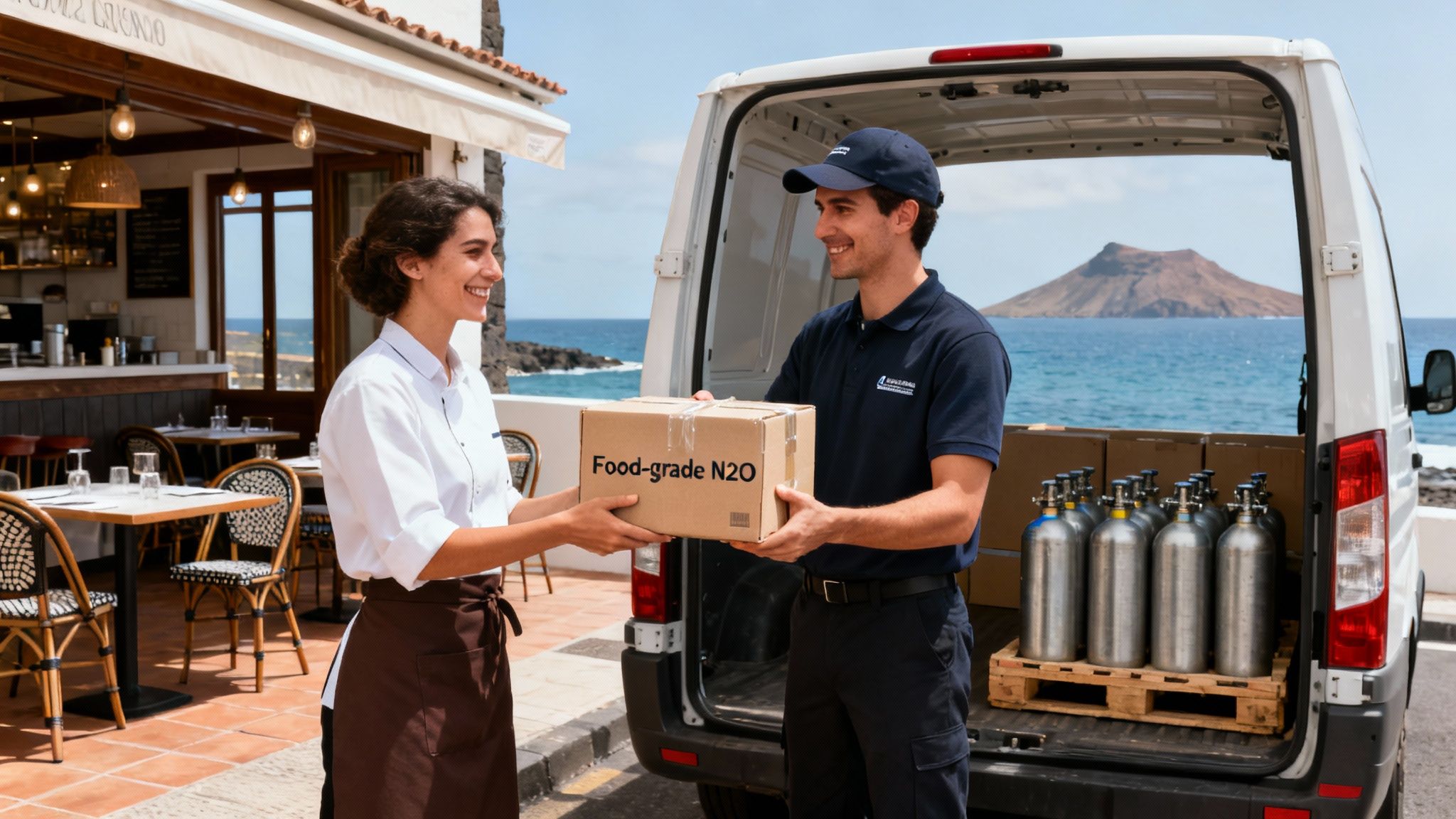
Here in the Canary Islands, reliable logistics aren't just a part of the business—they're the entire foundation. Getting a consistent supply of essentials, especially bombonas oxido nitroso, can be a nightmare of inter-island transport and customs headaches. This is precisely where finding a local distribution expert stops being a choice and becomes your biggest strategic advantage. It turns your supply chain from a constant worry into a well-oiled machine.
Think about it. A local partner knows the rhythm of the islands. They know the ferry timetables by heart, they've navigated the customs paperwork a thousand times, and they know the quickest back routes to get product from their warehouse to your door. Whether you're running a bustling resort in Tenerife or a quiet cocktail bar in Gran Canaria, that insider knowledge is what prevents the kind of delays that can kill a service during high season.
The Power of Same-Day Delivery
For any venue with high turnover, running out of a key ingredient mid-service is simply not an option. Having access to same-day delivery completely changes the game. It allows you to adopt a much smarter 'just-in-time' inventory model. Instead of sinking capital into excess stock that hogs precious storage space, you can operate lean, knowing a fresh supply is just a quick phone call away.
The difference this makes is immediate and tangible:
- Lower Storage Costs: Less stock cluttering up your storeroom means more room for operations and fewer overheads.
- Better Cash Flow: Your money isn't just sitting on a shelf gathering dust.
- Zero Stockouts: You’ll never again have to deal with the lost sales and customer frustration that come from an unexpected rush.
"Predictability is profit. Knowing our N2O supply is guaranteed daily allows us to focus on guest experience, not inventory counts. It’s an operational advantage that directly impacts our bottom line."
For businesses in the main hubs, this service means you never have to tell a customer "no" because you've run out of bombonas oxido nitroso. You can see exactly how it works in our guide to same-day N2O delivery in Gran Canaria.
Boosting Your Bottom Line with Volume Discounts
Beyond the sheer convenience, partnering with a dedicated B2B supplier opens up some serious financial perks. A proper distributor program built for volume purchasing can slash your procurement costs. By consolidating your orders, you gain access to tiered pricing that directly cuts your cost-per-unit.
For a large hotel or a busy catering company, those savings add up fast, giving your venue's profitability a healthy boost. A solid local partnership gives you more than just products; it delivers operational stability. You get a reliable pipeline of certified, high-purity nitrous oxide, backed by a logistics team that truly understands the unique demands of the Canarian market. It lets you keep your service consistent, your costs down, and your focus exactly where it should be: on your customers.
Find a B2B Nitrous Oxide Supplier in the Canary Islands
Finding a reliable B2B supplier for bombonas oxido nitroso in the Canary Islands is crucial for any hospitality business. A professional local partner ensures you receive certified, food-grade E942 products with the necessary IGIC invoicing for full compliance. They understand the unique logistical challenges of inter-island transport and can provide services like same-day delivery to prevent stockouts during peak season.
Kings Canisters is a dedicated B2B supplier serving the Canary Islands, including Tenerife, Gran Canaria, Lanzarote, and Fuerteventura. We offer a full range of canister sizes and provide the professional documentation and reliable delivery your business needs to operate efficiently and legally.
- Website: kingscanisters.com
Ready to stop worrying about supply chain headaches and focus on your menu? Kings Canisters is the dedicated B2B partner for hospitality businesses across the Canary Islands. We provide certified, high-purity nitrous oxide with the reliable local delivery and IGIC-compliant invoicing you need to operate with confidence.
Explore our full range of products and our distributor program at KingsCanisters.com